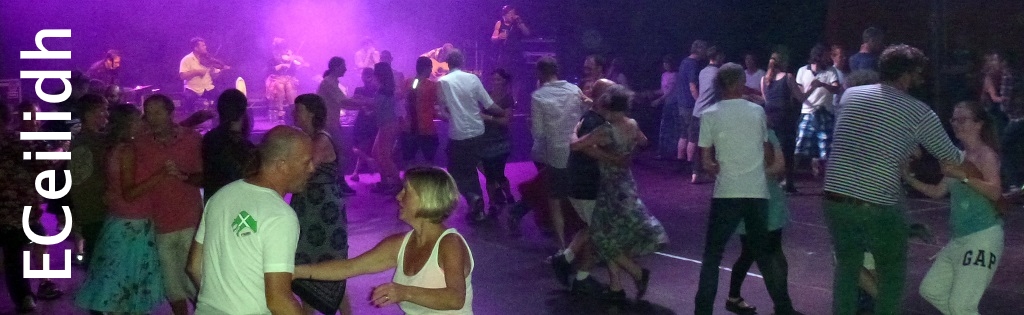
|
|
(Related: Getting dance partners)
by Steve Harris
This question is often asked by those going to their first ever ceilidh. This is my attempt at an answer.
There are two aspects to the answer:
Considerations of comfort, safety and other practical issues
Fashion considerations
1. You will get hot and probably sweaty
English Ceilidh is a fairly athletic dance form that often happens indoors with inadequate ventilation. Dress in a way appropriate to that. Quite a few people wear shorts. Women have additional options. Although a short skirt might seem an obvious choice some women find long skirts cooler. Short sleeved shirts/tops are popular. Be aware that standard T-Shirts may get wet through and uncomfortably clingy. A better choice may be a polo shirt. They may be thicker but with their open weave they may be better at getting rid of the sweat. It really depends on how sweaty you get!
If you had it in mind to have a haircut anyway, have it before the ceilidh. A lot of heat gets trapped in thick hair and sweat runs down out of it. Sports socks although absorbent tend to keep your feet too warm. Tights/stockings may keep your legs too warm as will high boots. (Some regulars travel to a ceilidh in high boots but nearly all of them change into something else before stepping onto the dance-floor) Consider not wearing anything on your legs. Clothing materials should not be too thick and while natural fibres used to be the obvious choice, there are many man-made fibres nowadays that let the heat and sweat out.
Tip for shy ladies: You may not be very comfortable showing parts of your flesh (EG: your arms) So put a long sleeved cardigan/fleece/etc over a T-Shirt. That way, when you boil over, you have the option of taking some clothes off
If you wear a cardigan/fleece/etc, consider using one with a full length zip or buttons so you can remove it without messing up your hair
2. You need to be able to move
Ok, it's not ballet but you need to be able to move your arms and legs quite a bit. Any clothing that will restrict your movements will be a problem. So make sure that nothing is too tight or restrictive.
Tip mostly for ladies: Try jumping up and down and waving your arms vigorously. Does anything malfunction? In particular, strap tops may slide off and you will end up having to readjust them every few minutes
Also for anyone considering a long dress: Try doing a twirl/spin wearing it at home - ideally about 50cm away from another person. If the garment flies out and makes contact with your assistant, it may be unsuited to dancing on a crowded dance-floor
Similarly, very long hair may fly out and contact other dancers unless restrained.
Hats are likely to get in the way and get knocked off
3. Footwear
Perhaps the most controversial subject. Quick summary first:
Minimal or no heels
Not hard
Plenty of cushioning
Some grip
Now, more detail:
High Heels are almost always wrong
Very few people dance English Ceilidh better in high heels
Many experienced dancers believe that high heels are the sign of a novice who will be difficult if not downright dangerous
The dress code has absolutely no expectation of high heels being worn
Your chances of injury or hurting someone else is greatly increased
Some men are reluctant to ask women who are taller than them for a dance. If you are already above average height, flat shoes may be best.
So what shoes are right?
The answer to this depends on how you dance and what the floor is like:
Some dancers move around the floor by lifting their feet off the floor, moving them through the air and then putting them down. When they move a foot through the air, they usually keep the other one in firm contact with the floor. Such dancers need their shoes to have grip otherwise that firm contact with the floor isn't going to work. They also like some padding to absorb the impact with the floor. Trainers are popular with these dancers. However, when they turn corners, there is a tendency to turn the upper body while leaving the foot firmly on the ground. This twists the knee joint and can result in injury. Shoes are available that allow the foot to rotate while still giving plenty of traction.
Other dancers tend to slide around more. They need a shoe/floor combination that allows them to slide but still have enough grip. This is quite a tricky requirement - if the caretaker polishes the floor one week but not the next, these dancers will notice.Such dancers may travel with two or more pairs of shoes so they can adjust.
Sandals, other open shoes and bare feet have their place: All these options have more ventilation and cool the feet. The intimate contact between bare feet and the floor is enjoyed by some people. Of course, you have less protection if your feet are stepped on and you could step on something nasty or damaging. I recall one venue where a barefoot dancer was ordered off the floor by staff on the grounds of Health and Safety. That said, I'm not aware of any injuries aggravated by bare feet. Wooden floors that look OK rarely have splinters. Since your feet spend most of their time under you (rather than anyone else) they may well escape being stepped on although more crowded dance floors may be a problem. Also, while some accidental foot-foot contact certainly does happen on the dance floor, getting your feet stamped on and seriously injured isn't likely - especially if the other person isn't wearing clumpy heels.
The floor (and hence the right shoes for you) can vary - even within the same dance. Some keen dancers moan about such things. Others root around in their bag for an alternative pair of shoes.
What works for you at other dance types may not be right for ceilidhs
4. Fashion Issues
Stetsons, check shirts and cowboy boots are not worn by the regulars. You won't get thrown out for wearing them but you will be quietly laughed at. There is no finer way to announce that you are a beginner.
Scottish clothes such as kilts for men are Ok and seen occasionally. There may be an expectation that you can dance well and vigorously although in the (different) Scottish style.
No one expects you to be fashionable in the street or nightclub sense.
Brightly coloured clothes are often worn by men and women especially at festivals. Black is also Ok. You can also wear drab clothes if you want.
When you actually get to your first ceilidh, you may notice some new fashion trend amongst the regulars. I've seen painted desert boots, floral trousers for men, one-bar sandals for women, Crocs, T-Shirts that change colour when hot, etc. Sometimes these things really do work well for dancing. Other times, it's a pure fashion thing. Recognise this and make your own decisions. (Actually, lightweight desert boots work really well for me but they go in and out of fashion so I tend to buy them on sight!)